One stockpile, five theaters drawing on it at once
The munitions expended in Iran were never earmarked for the Middle East alone. The same stockpile sustains standing U.S. commitments in Europe and the Red Sea — and it is the stockpile U.S. forces would need in any potential confrontation in the western Pacific.
An analysis by Arabic Post of the stockpiles and production of key U.S. weapons used in the Iran war found that, within a matter of months, Washington consumed substantial portions of the inventories of some of its most important offensive and defensive missiles, while replacing the quantities fired of some types could take years.
Since the war began on February 28, available estimates have shown severe depletion of some of the most critical munitions used for missile defense and long-range strikes.
While the U.S. Department of War (the Pentagon) does not disclose the actual size of its stockpiles, estimates of the extent of depletion vary. This analysis therefore presents the available figures as reported by their respective sources, without favoring one estimate over another.
These figures do not mean that the United States is about to run out of weapons. What the comparison between consumption and production reveals is a gap between the rate at which certain munitions have been drawn down from stockpiles and the time factories need to replace them. Even before the additional consumption that followed the resumption of combat operations, a study published in May estimated that restoring Patriot, THAAD, and Tomahawk inventories to prewar levels could take three years or more.
The significance of this gap extends beyond the Iran war, as the weapons being consumed include munitions that U.S. forces would also need in other military scenarios, particularly in the Western Pacific.
How did Arabic Post calculate the figures?
The analysis covers the period from February 27 through August 2026. Because the Pentagon does not publish figures for most of its munitions stockpiles, Arabic Post compared estimates of prewar inventories of several key weapons with the quantities consumed during the war, and then with production rates and new orders, to gauge the scale of depletion and the time required to replenish them.
The analysis drew on U.S. budget, procurement, and delivery documents; contracts and disclosures from manufacturers; information reported by reliable media outlets citing officials familiar with the matter; and estimates by specialized research institutions. It distinguished between official figures, open-source estimates, and information attributed to officials, as well as between actual production and targeted production capacity.
The aim is to answer two questions: What has the Iran war done to U.S. weapons stockpiles? And how long will the United States need to restore them to prewar levels?
What is left? Nine U.S. systems after six months of the Iran war
Each figure below is the share of that system reported as expended, exactly as its source stated it. Where estimates diverge, the bar shows the full range between the lowest and highest figure rather than favoring either one — the figure shown is the range itself, not one end of it.
Pre-war stockpile: roughly 2,330 interceptors
The widest gap between sources in this analysis
Pre-war stockpile: roughly 3,100 missiles
No reliable data on later consumption
Remaining quantities undisclosed — not described as depleted
The Army is transitioning to the Precision Strike Missile
Current inventory unknown
Research estimates with no operational disclosure
About a quarter of the fleet lost
Five months of attrition: How have U.S. weapons stockpiles changed?
The Pentagon does not disclose the actual size of most of its missile stockpiles, as the information is classified. There is therefore no official tally that can be used to compare the state of the U.S. arsenal after months of war with where it stood on February 27. However, procurement and delivery documents, reports from U.S. officials familiar with stockpile data, and estimates from reputable research institutions, including the Center for Strategic and International Studies, make it possible to construct an approximate picture of what happened.
The Center for Strategic and International Studies reconstructed stockpile levels using Defense Department budget documents and missile delivery schedules, then deducted prior expenditures, training use, and transfers to Ukraine. The center stresses that its findings remain estimates rather than official stockpile figures.
Missile defense: Two-thirds of Patriot and more than one-third of THAAD
The depletion is particularly evident in Patriot missiles, one of the United States’ most important lines of defense against ballistic missiles. The Center for Strategic and International Studies estimates that the United States entered the war with roughly 2,330 interceptor missiles before using between 1,060 and 1,430 during the first phase of fighting.
The depletion did not stop when operations resumed. By August, differing estimates had emerged regarding the scale of the decline. Reuters cited informed sources as saying that U.S. forces had used about 65% of the Patriot stockpile—an estimate the sources said was consistent with internal U.S. data—while CNN cited sources familiar with a more recent assessment as saying that about half of the Patriot stockpile had been consumed.
The situation with THAAD is not much different, although the disparity between sources is greater. Reuters said an estimate indicating that the stockpile had fallen by at least 38% was consistent with internal U.S. data, while CNN, citing informed sources, reported that nearly 80% of the THAAD stockpile may have been consumed.
Tomahawk: One war consumes nearly half the stockpile
On the offensive side, Tomahawk was among the missiles most heavily depleted. The Center for Strategic and International Studies estimates the prewar stockpile at around 3,100 missiles, with more than 1,000 used by the time of the first ceasefire, according to the center’s update based on media reports and budget documents.
Subsequent fighting, however, pushed that total higher. In August, Reuters cited sources familiar with stockpile data as saying that U.S. forces had used just under half of the Tomahawk inventory since February 28. The sources did not disclose the precise number of missiles remaining, so this analysis retains the description “just under half” rather than converting it into a numerical figure that might not account for deliveries or other uses.
JASSM: A quarter of the stockpile in the first phase alone
The stockpile of Joint Air-to-Surface Standoff Missiles (JASSM) came under similar pressure. The Center for Strategic and International Studies reconstructs the prewar inventory at around 4,400 missiles, while the data it compiled indicate that approximately 1,100 had been launched by the time of the first ceasefire.
That means the first phase alone may have consumed around a quarter of the estimated stockpile. However, there is not yet enough reliable data to determine additional consumption after fighting resumed, meaning the current inventory cannot simply be calculated by subtracting the missiles used in the first phase from the February stockpile.
Precision Strike Missile and ATACMS: “Virtually all” available stocks
The picture becomes more acute with the Precision Strike Missile, a relatively new weapon whose stockpile was smaller to begin with. By August, Reuters cited sources familiar with stockpile data as saying that the military had used “virtually all” available quantities of Precision Strike Missiles and ATACMS during the war. The report did not specify how many missiles of each type remained, so neither can be described as having been completely “exhausted.”
The distinction is important: while the Patriot and THAAD figures reflect substantial reductions in inventories comprising hundreds or thousands of missiles, the Precision Strike Missile and ATACMS cases demonstrate how quickly long-range, ground-launched strike munitions can be depleted when available quantities are smaller to begin with.
Standard Missile-3 and Standard Missile-6: Clear depletion, current inventories unknown
The available data make it easier to measure first-phase consumption of the naval air and missile defense weapons Standard Missile-3 and Standard Missile-6 than to determine their current status. The Center for Strategic and International Studies estimates prewar inventories at around 410 SM-3 missiles and approximately 1,160 SM-6 missiles, with between 130 and 250 of the former and between 190 and 370 of the latter used during the first phase.
These figures, however, are insufficient to calculate August stockpiles because there is no publicly available data detailing subsequent use or newly delivered missiles added to inventories. The analysis therefore does not provide a current figure for either missile.
Reaper: A quarter of the fleet lost
The impact of the war is not limited to missiles. In the case of MQ-9 Reaper drones, depletion can be measured in terms of the platforms themselves. On August 13, the Washington Post cited three U.S. officials as saying that the military had lost at least 45 drones during the war, equivalent to roughly 25% of the fleet.
That does not mean the current inventory can simply be calculated by subtracting 45 drones from the previous fleet size; deliveries, retirements, or other changes may have affected the total. But the loss rate itself is documented, making the Reaper one of the clearest examples of direct depletion of a U.S. military platform during the war.
Not a single crisis
The comparison reveals three different degrees of depletion: high rates for Patriot, THAAD, and Tomahawk; Precision Strike Missiles and ATACMS approaching the consumption of virtually all available stocks; and the loss of roughly a quarter of the Reaper fleet.
These figures do not mean that the U.S. arsenal has been “exhausted.” Following the first phase, the Center for Strategic and International Studies concluded that the United States still had enough weapons to continue the war under plausible scenarios. It warned, however, that the depletion increases the risks associated with a future war requiring the same weapons, particularly in the Pacific.
Can U.S. arms manufacturers replace what has been consumed?
After five months of war, the problem facing the U.S. arsenal is no longer just about how many missiles remain. The more important question is how long it takes to produce a replacement for every missile drawn from stockpiles.
The answer emerging from company documents, new contracts, and Pentagon reports is not the same for every weapon. While Washington is pouring tens of billions of dollars into production lines, output of some missiles can be increased more quickly than others, while for other systems it will take years before new contracts translate into actual munitions in stockpiles.
The pressure appears significant enough that, in August, the Pentagon asked arms manufacturers to submit plans within 21 days to accelerate deliveries and increase production of critical capabilities. The Associated Press quoted Pentagon spokesman Sean Parnell as saying that the department was working to increase munitions purchases to provide weapons “at the pace the threat demands.”
Tomahawk: A leap from 60 to 1,000 missiles
The Tomahawk case clearly illustrates the scale of the gap between consumption and production. While the United States used just under half of its stockpile during the war, the production rate allocated to it was only about 60 missiles per year.
On August 17, the U.S. Navy awarded Raytheon, a subsidiary of RTX, a seven-year contract worth $22.9 billion to raise annual production to more than 1,000 missiles. That means the targeted capacity is more than 16 times the current production rate.
But 1,000 missiles is a production-capacity target, not the production rate currently available. Before the war broke out, Raytheon had already signed a framework agreement with the government to increase production of Tomahawk, Standard Missile-3, Standard Missile-6, and AMRAAM, indicating that the industrial-capacity problem predated the Iran war, even if the conflict made it more urgent.
Patriot: The factory is expanding, but demand is global
Expansion of Patriot PAC-3 MSE production had also begun before the war. Lockheed Martin says it delivered 620 missiles in 2025 after increasing production by more than 60% over two years. In January 2026, it agreed with the U.S. government to raise annual capacity from around 600 to 2,000 missiles.
However, that figure will not be reached before the end of 2030, according to company CEO Jim Taiclet, who said achieving the target requires expanding capacity across the entire supplier network in parallel with the main production facility.
In July, the plan became a massive financial commitment. Lockheed Martin received a multiyear contract with a total potential value of $58.62 billion to produce Patriot PAC-3 MSE missiles.
THAAD: A smaller production line facing greater demand
The challenge appears more difficult with THAAD. Its stockpile is smaller than Patriot’s and its production line is limited, while the war consumed at least 38% of what the United States possessed at its outset.
Data published by the Financial Times in July indicate that the U.S. Missile Defense Agency placed a $35 billion order to quadruple THAAD production. This came as revenue in Lockheed Martin’s missiles division rose 19% year on year in the second quarter, driven partly by increased production of Patriot and Precision Strike Missiles.
In August, the Pentagon took another step to address supply-chain bottlenecks, reaching agreements worth more than $3 billion with Lockheed Martin and Northrop Grumman to increase production of Patriot and THAAD components. The plan includes establishing a second source for the solid rocket motors used in Patriot missiles, alongside quadrupling THAAD production.
Standard Missiles: Expansion began before the first missile was fired
As for Standard Missile-3 and Standard Missile-6, the Defense Department moved to increase their production weeks before the war began.
On February 4, Raytheon signed five agreements extending for up to seven years to increase production of several key munitions. The plan includes both the Standard Missile-3 Block IB and Block IIA, as well as raising Standard Missile-6 production to more than 500 missiles annually.
The company does not disclose the targeted annual production rate for each Standard Missile-3 variant in the agreement.
Precision Strike Missile: Depleting the stockpile while accelerating its replacement
In the case of the Precision Strike Missile, production is being expanded as the Army transitions from ATACMS to the newer weapon. This is particularly significant after U.S. forces, according to the data discussed earlier, used “virtually all” available quantities of both weapons during the war.
The Financial Times reported that the Precision Strike Missile, along with Patriot, was among the programs that drove higher revenue in Lockheed Martin’s missiles division during the second quarter of 2026. The company’s total backlog also reached around $230 billion, an indication of the scale of demand its production lines must absorb.
Funding is no longer the only problem
The United States, then, does not appear incapable of replacing what it has consumed. The contracts are in place, funding is increasing, companies are expanding their factories, and the Pentagon is pushing them to produce quantities that the U.S. defense industry was not designed to manufacture annually just a few years ago.
But money and contracts do not rebuild stockpiles overnight. Lockheed Martin, for example, will not reach its target of producing 2,000 Patriot missiles annually until the end of 2030, even though the expansion agreement was signed at the beginning of 2026.
This is where the gap created by the war lies: The United States can increase missile production, but in several systems, the rate of consumption in a high-intensity war has outpaced the rate at which factories can replace them.
The question, therefore, is no longer whether the stockpiles will be rebuilt, but how long the process will take—and which missiles will remain below their February 27 levels for the longest?
The money is there and the contracts are signed — but the factories need years
From the expansion that began before the war to the targets that will not be met before the end of the decade: what Washington signed, and when it turns into munitions on the shelf.
A multilayered arsenal: What did the United States use in the Iran war?
The United States entered its war against Iran on February 28 with an arsenal combining long-range strike capabilities, multilayered missile defense, and air and naval power.
Data from U.S. Central Command show the involvement of bombers, fighter jets, attack aircraft, and drones, alongside Patriot, THAAD, and HIMARS systems, destroyers, submarines, and aircraft carriers in Operation Epic Fury.
On the offensive side, Central Command documented U.S. destroyers launching Tomahawk land-attack missiles from the first day of the war. The Precision Strike Missile also saw its first combat use, with Lockheed Martin announcing that Central Command confirmed its first operational use on March 4.
U.S. forces also used ATACMS before Reuters reported in August, citing U.S. officials, that the military had consumed virtually all available stocks of ATACMS and Precision Strike Missiles during the war.
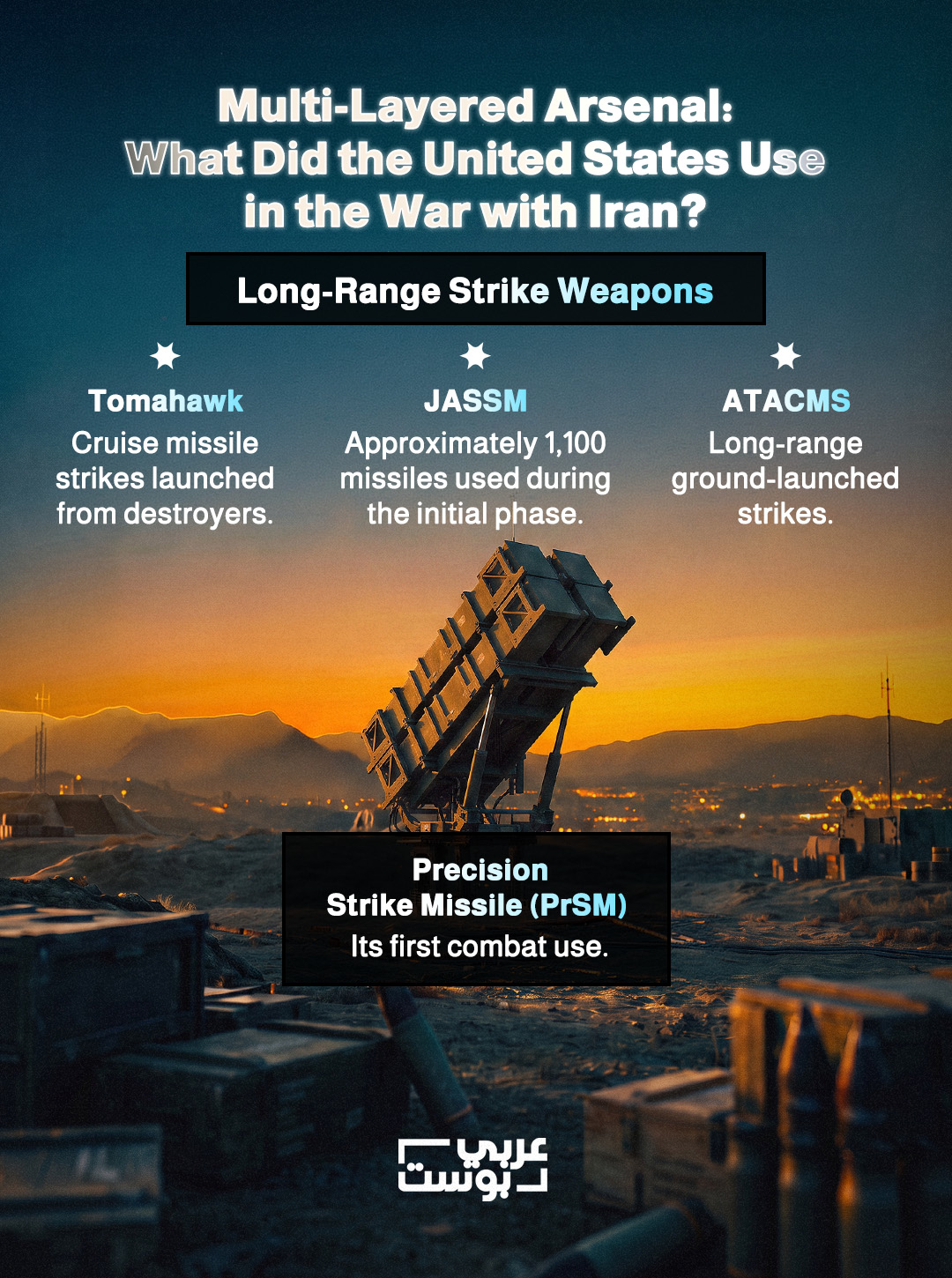
In the air, data compiled by the Center for Strategic and International Studies from U.S. media reports indicate extensive use of Joint Air-to-Surface Standoff Missiles (JASSM), with an estimated 1,100 missiles launched by the time of the first ceasefire.
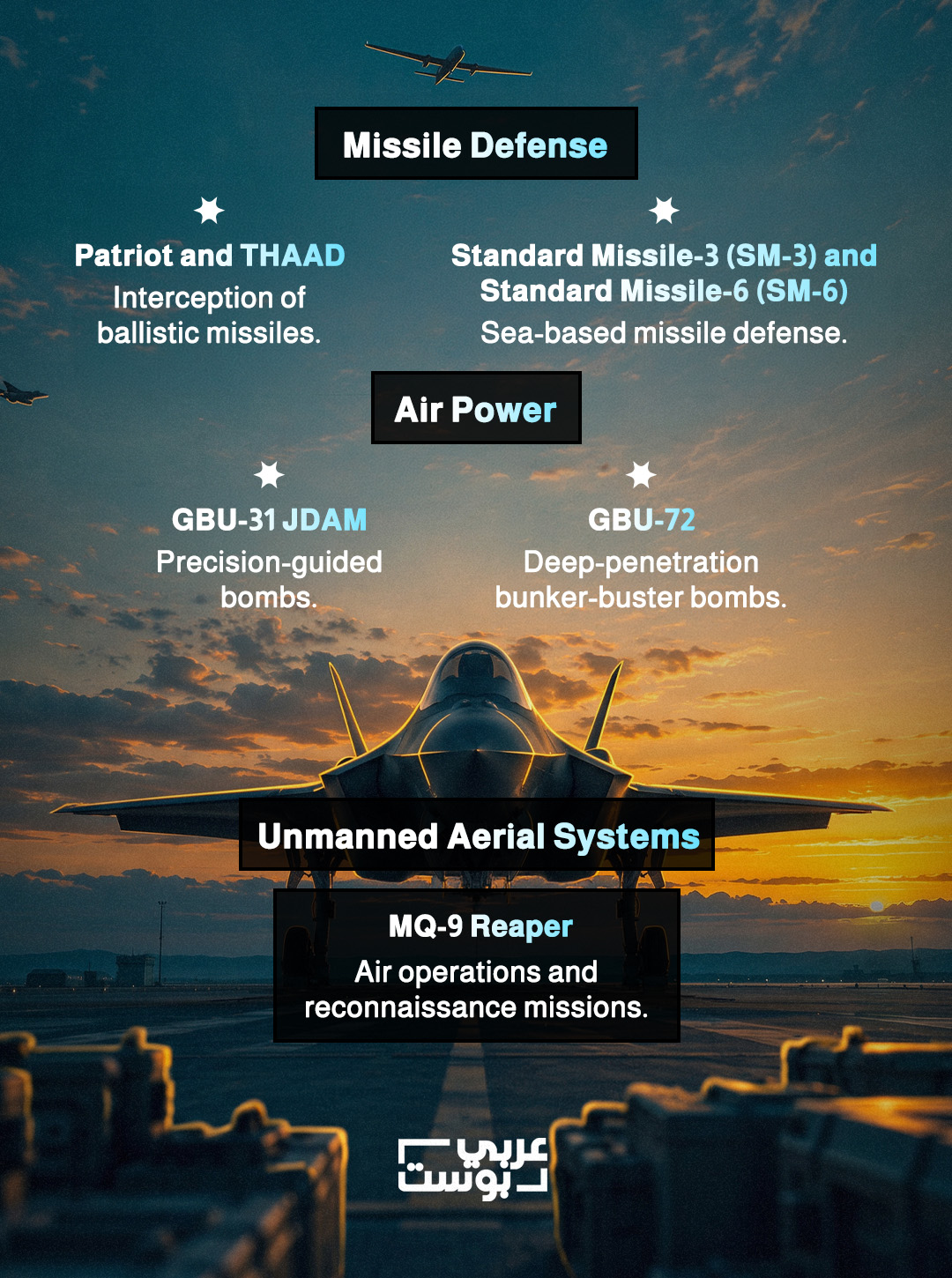
On the defensive side, U.S. forces employed both Patriot and THAAD systems, while destroyers took part in naval missile defense. Central Command published documentation of a Standard Missile-3 being launched to intercept a ballistic missile.
The Center for Strategic and International Studies also lists Standard Missile-6 among the munitions consumed, estimating that between 190 and 370 were launched during the first phase. However, we found no published operational disclosure from the Pentagon specifying its use or the quantities involved, so these figures remain research estimates.
Reports also documented the use of GBU-31 JDAMs and, citing informed sources, reported the use of GBU-72 bunker-buster bombs.
MQ-9 Reaper drones occupy a different category: they are reusable platforms rather than munitions that disappear from stockpiles after being fired, but losing them represents direct depletion of the fleet. Their impact is therefore measured by comparing the number of drones lost with the size of the prewar fleet.
Despite the breadth of the arsenal used, the depletion assessment focused on weapons whose stockpiles can be tracked with reasonable confidence: Patriot, THAAD, Standard Missile-3, Standard Missile-6, Tomahawk, long-range JASSM, Precision Strike Missile, ATACMS, and MQ-9 Reaper. Bombs and other platforms are excluded from the comparison unless reliable data are available to measure their stockpiles before and after the war.
Did the United States enter the war with its stockpiles already under pressure?
Pressure on U.S. munitions stockpiles did not begin with the Iran war, according to Britain’s Financial Times. Since Russia’s invasion of Ukraine in February 2022, Washington has drawn billions of dollars’ worth of weapons and munitions from Defense Department stockpiles for delivery to Kyiv, while simultaneously beginning the process of replacing what had been taken from its warehouses.
By March 2024, Congress had appropriated $25.9 billion that the Pentagon could use to replace weapons transferred to Ukraine. According to the U.S. Government Accountability Office, munitions, missiles, and combat vehicles accounted for most of the spending, while the Defense Department also allocated funds to expand the production capacity of the defense industrial base.
Pentagon data show that these drawdowns included some of the same types of weapons that would later become central to the Iran war. In May 2024, the Defense Department announced a package drawn from U.S. stockpiles that included additional munitions for Patriot and HIMARS systems, as well as precision air-to-surface munitions. In July of the same year, the United States, alongside Germany and Romania, pledged to send additional Patriot batteries to Ukraine.
In the Red Sea, another source of consumption emerged before the Iran war. In March 2024, the Navy requested an additional $92.9 million to accelerate the replenishment of Standard Missile-2 inventories after the missiles were used in operations to protect shipping. It said some missiles in its inventory were not suitable for combat use until they had undergone recertification.
These developments indicate that replenishment pressures were not new when the Iran war began. U.S. forces had already been drawing on their stockpiles for Ukraine and Red Sea operations, while the Defense Department was seeking funding and faster production even before February 2026.
At the same time, manufacturers had already begun increasing production of certain munitions. Boeing said it delivered more than 500 Patriot missile seekers in 2024, a company record and an indication that the supply chain was already expanding before the Iran war.
Thus, the data do not establish that the United States entered the Iran war suffering from a “general shortage” across its arsenal—a characterization that the classified nature of the relevant data does not permit. But they do establish something more specific: the war began after parts of U.S. munitions stockpiles had undergone years of drawdowns and use, while the Defense Department was already spending billions of dollars to replace weapons and expand production lines.
Beyond Iran: What Does the Erosion of Stockpiles Mean for U.S. Readiness?
Declining missile stockpiles do not mean that the U.S. military has become incapable of continuing to fight. Even as some munitions have fallen to critically low levels, the U.S. administration says its forces still have what they need to conduct operations. The problem lies elsewhere: every missile consumed in Iran reduces, even if only temporarily, the margin available to respond to a second crisis elsewhere in the world.
These concerns are not entirely theoretical. In August, the Wall Street Journal reported that the White House maintains the military has sufficient munitions for any operation ordered by the president, even as leaks concerning stockpile levels prompted President Donald Trump to call for investigations into how the information emerged from the Pentagon.
China: The problem behind the Iran numbers
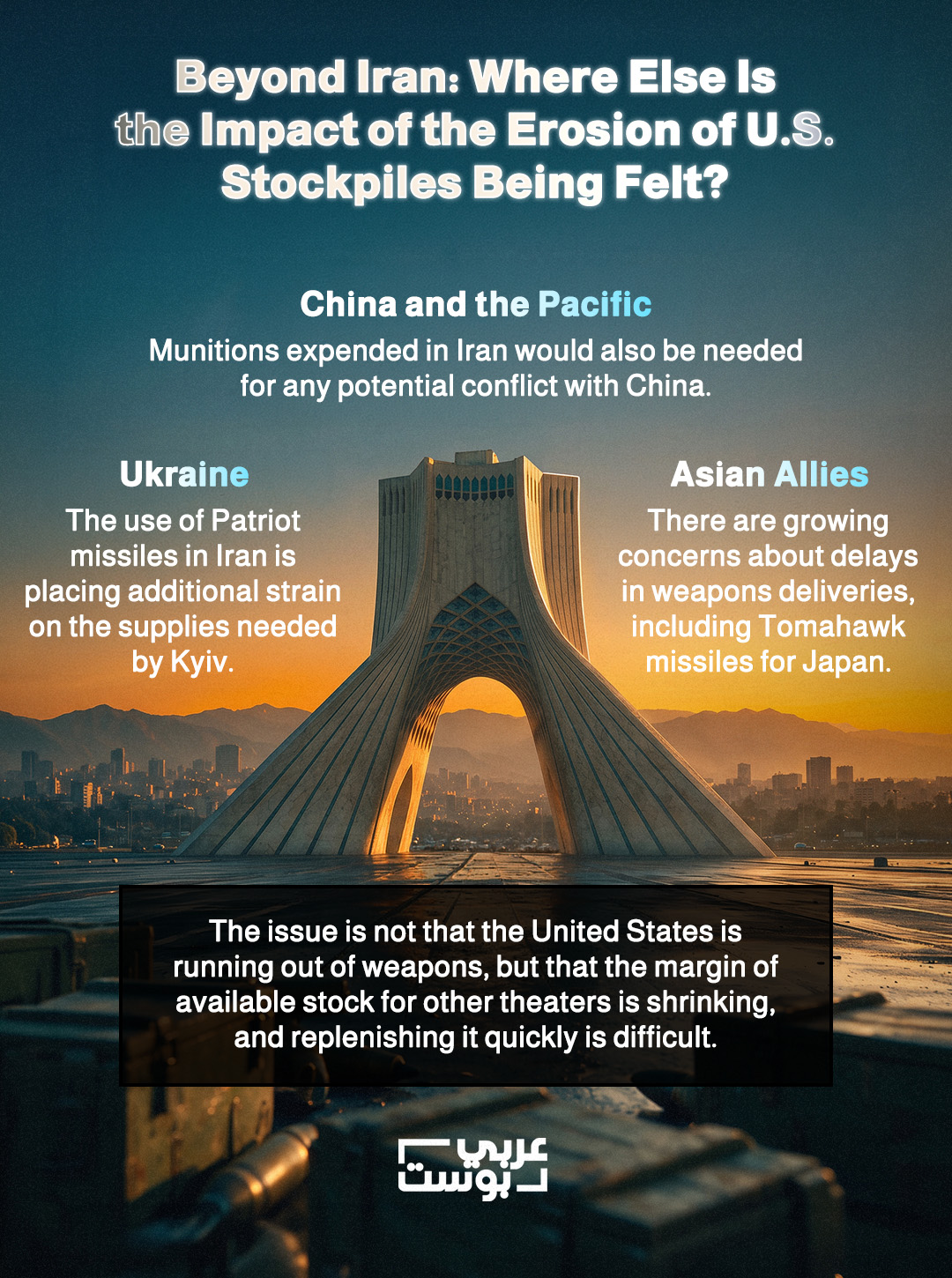
This gap takes on particular significance in the Pacific. Many of the weapons consumed in the Iran war are not munitions intended exclusively for the Middle East; they are also part of the arsenal U.S. forces could need in a potential conflict with China.
This is particularly evident with the long-range JASSM. U.S. forces used large numbers of the missile against Iran, while USNI News, published by the U.S. Naval Institute, says JASSM and its anti-ship counterpart, LRASM, remain important weapons for U.S. commanders in the Indo-Pacific region in confronting China. The Air Force is therefore working in parallel to increase production of both missiles.
The same applies to other munitions. The Center for Strategic and International Studies says that the seven weapons whose depletion it examined in the Iran war include munitions that would also be used in any conflict with China in the Western Pacific. The center concluded that the United States does not face the risk of running out of the munitions needed to sustain the Iran war under plausible scenarios, but that the greater risk lies in a future war requiring the same stockpiles.
But does that mean deterrence against China has weakened?
Here, assessments do not entirely agree.
The Financial Times argues that the depletion in Iran is putting pressure on weapons, some of which had been earmarked for a potential Taiwan scenario, and that the years required to rebuild stockpiles could create a period during which the U.S. arsenal would be more vulnerable to strain if another crisis erupted.
Researchers at the Brookings Institution, however, offer a more cautious assessment. They acknowledge that munitions shortages are a genuine problem requiring swift action, but argue that lower stockpiles alone are unlikely to cause U.S. deterrence against China to collapse. Beijing’s decision on whether to attack Taiwan would depend on a much broader range of military, political, and economic factors, not simply on the number of U.S. missiles remaining.
The impact has already reached U.S. allies
The pressure is not confined to the scenario of a future war. There are indications that redirecting resources to the Middle East has already begun to affect existing U.S. commitments.
On August 18, the Financial Times reported that Asian allies were concerned about the Iran war’s impact on stockpiles and delays in weapons deliveries, including Tomahawk missiles intended for Japan. This coincided with the redeployment of the aircraft carrier USS George Washington from the Pacific to the Middle East, leaving the region, according to the newspaper, without a U.S. aircraft carrier presence for the time being.
In Europe, the problem has been more apparent with Patriot. From the first days of the war, reports warned that the intensive use of PAC-3 missiles to defend U.S. forces and allies in the Gulf could put pressure on supplies intended for Ukraine. Reuters reported in March that analysts and officials were concerned that a prolonged war could delay deliveries to Kyiv, with production insufficient to meet global demand in the short term.
By August, the gap had become more pronounced. The Associated Press reported that Ukraine was still requesting additional Patriot missiles to defend its infrastructure against Russian strikes, while noting that the Iran war had become one of the factors contributing to shortages in available supplies.